 Utah Classical Music of the Past
Gallery of new recordings of old music - for the curious or the studious
Utah Classical Music of the Past
Gallery of new recordings of old music - for the curious or the studious
We admit that we are posting these as synthesized vocal recordings, or with instruments replacing vocals to illustrate the quality and range of music of those early years. But we don’t pretend that these versions with synthesized voices are as good as real vocal recordings. Too much of the phrasing and feeling is missing. There is not yet a great solution to solve the limitations of synthesized vocals. More selections with better audio may be available as we upgrade later in 2026.
There are also *many* novelty songs in a more popular vein that could be added here someday, but for those the “wordplay” almost requires clear, well-phrased, live vocals. So this batch will be mostly choral offerings, making this section lean a bit more on music composed for religious services than most others pages of this site.

There’s Love in her Bright Blue Eye, a song for Tenor and chorus from 1877 by the prolific Joseph J. Daynes. The tenor sings the verse solo, then is joined by an s.a.t.b. quartet for the short chorus. This demo recording presents just one verse/chorus with the voices replaced in the recording by synthesized vocals, as will be standard on this site for technical reasons. (Audio only – click to listen.)
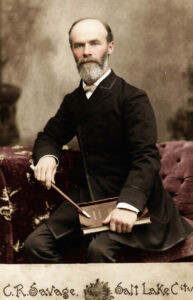
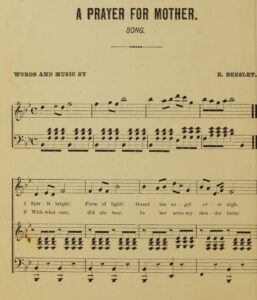
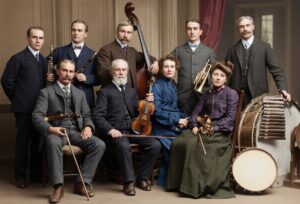
A Prayer for Mother (1877 – date approximate) was by the prolific Ebenezer Beesley. Photos above. (1840-1904) He came from England to Utah as a newlywed, and was an actual handcart pioneer in 1859. A natural musician, he led the Salt Lake Theater Orchestra, which included less than a dozen players but which was, for that time, the closest thing that the valley had to a professional orchestra. From 1880 he was director of the Tabernacle Choir for a decade, and was instrumental in compiling hymnbooks for the LDS Church which elevated the levels of other regional musical talent. He founded a retail music store which lasted until the 1980s in various SLC locations. As a composer his output was large, but largely hymns on sacred or faith-promoting subjects. This selection is a typical song with piano accompaniment, but on a more general, sentimental subject, and one where he wrote both words and music. (Audio only – click below to play.)
Oh, How Wicked the Mormons Are was one of many comic songs of the late 1800s making merry about Mormons, and by extension, anyone in Utah. Some were less tongue-in-cheek, but this one was mostly for fun. From the limited info printed on the sheet music it might have been from the “Music Hall” shows in England that were like Vaudeville in the Americas. When we figure out how to present vocals this will be one of the first we re-post.
Deseret – or a Saint’s Affliction was a “Comic Opera” from 1880 by major composer Dudley Buck, noted as being among the first respected composers to be educated entirely in America. A friendly lampooning of Mormon, and by extension Utah life. But really more of a “romantic troubles” plot compounded by the shadow of polygamy, which was how many in east coast circles saw Utah. Easy to joke about, but not particularly mean-spirited. The composer later had several of his choral anthems included in LDS songbooks for choirs and Temple dedications, so no hard feelings. Most of the musical score of this full opera is lost, but seven short songs were published separately, and this piece, titled “Serenade”, is one of those. Starts as a solo for a Baritone voice as he sets out to woo a particular young lady. But as he sings outside her window, he accidently captures the attentions of all the OTHER ladies in the area, who join in his song. (Audio only – click below to play.)
The Gushing Rill was a “Temperance Song” published around 1894 (?) to persuade youth not to drink alcohol, despite the temptations in society. The melodramatic lyrics were used in hymnbooks of other faiths for decades before Evan Stephens made his version with an original tune. The most dramatic lines include, “For in each shining, crystal round, a deadly lurking fiend is found”, and “The taste of bitter tears is there, the tears of grief and dark despair.” (Audio only – click below to play.)
Our Father in Heaven from 1893 was one of several new compositions by various noted local composers performed as part of the multi-day dedication services when the Salt Lake City temple of the LDS (Mormon) Church was finally opened, almost 50 years after the arrival of the pioneers. Lewis D. Edwards was one of many musicians tutored and encouraged by Evan Stephens. His music, along with lyrics by Elsie Booth, made this anthem a favorite among the public who attended those services. It makes a good first impression for the tuneful simplicity, without as much complexity as the other selections for that program. (Audio only – click below to hear it with synthesized voices.)
“Gloria” from 1895 by John J. McClellan, Tabernacle organist from 1900 to 1930. This selection was originally for chorus and orchestra, then later published in a version for chorus and organ. This is a single movement from his larger five-movement “Mass in E-flat”. The full Mass was performed in Michigan where the composer went to college to study in a music conservatory. He then returned to Utah where the Tabernacle Choir performed this single movement, with the lyrics translated from Latin to English by Evan Stephens. Note that this recording is only the first half of the piece, due to the complexity and the time (many hours!) required to do the notation. And it does not include the many organ voicings suggested in the score for instruments with stops to simulate brass, flutes, etc., due to the limitations of the software used. I’ll probably finish this recording someday when it can include real vocals to better reflect the original concept. (Audio only, click to play.)
Slumber Song is added here, a bit out of chronological order, because it is another vocal selection from McClellan, but in a very different mood and form this time. Published in 1903 for voice and piano, forgive us for presenting it here adapted for Irish flute handling the vocal line. Short and sweet, but this time both verses are included as the solo melody line has a few changes in the second verse to follow the lyrics/meter of the words by Ruth Eldredge. (Audio only, so hit it.)
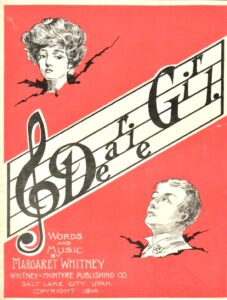
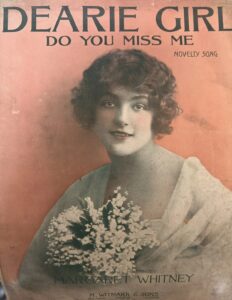
Dearie Girl (Do You Miss Me?) was just one of dozens of popular songs included in Salt Lake City composer Margaret Whitney’s many shows. At the time, some were referred to as Operas, others as operettas, and some as musical comedies. She must have been a young dynamo of creativity, as she composed and staged about one full-length show per year in her teens. This show had a basic musical comedy plot where a great girl was fond of a composer of ragtime music, but this particular song is more of a sentimental romantic ballad sung by a man who is afraid that the girl he loves is not waiting for him back home. This site often shares new recordings with synthesized instruments because historic recordings are unavailable, but for this one we are happy to link to an early 78-rpm record someone else posted. As one of the earliest local women composing commercially successful popular music we shall keep looking for more of her music to share here. (Click the title at the start of this item to hear it in a YouTube video.) The following photos include the covers of the first two editions of sheet music for this song, including the self-published 1914 original and the 1915 edition re-printed through a major national music publisher. And an AI update from a b/w photo from a 1914 local newspaper story about her.

Lullaby from 1917 with music by Charles Frederick Carlson and lyrics by Bertha Kleinman. Kleinman was a published poet and an officer in the LDS Church’s youth programs. Carlson may just be the most interesting “unknown” Utah composer of the early decades of the 1900s. (Check out his set of 3 short piano solos on the piano pages.) He was born in Utah, studied in the Midwest and Europe, and was on university music faculties in Colorado and Utah. He wrote at least four grand operas, several cantatas, piano pieces, and over 100 songs. This one is for Sopranos (synthesized here) and piano, and might reflect an awareness of the French Impressionist composers. (Audio only -click to play.)
The Marching Song of the Utah National Guard by the popular and populist Evan Stephens. Published in 1917 as a song with some extra touches. It starts with a solo trumpet fanfare imitating a bugle call, then into the song for full choir (male and female voices), before finishing with some whistling by the men’s voices. Something for everyone! (Audio only – click below to hear it.)
Sego Lily was another song on a local subject, honoring the flower/bulb that provided food during the first tough year of the Pioneers in their new home. Both words and music are by K.E. (Karl E.) Fordham of Provo, Utah in 1918. His name appeared in a list of music department students graduating from BYU in 1913, and he seems to have been a music educator in public schools in various Utah towns and cities for years afterward. This song was printed for voice and piano, but we have taken the liberty of having the vocal line shared by Irish flute and violin to add a bit of variety to the simple repeating tune. Seemingly, the lyrics came first as a poem with quite a measure of popularity, so the author/composer added music a bit later. (Audio only – click below to play.)
Utah – A Mormon Foxtrot by English (?) composer Elliott Smith from 1922 has the feel of a “Music Hall” entertainment song. The mood is dark, but the lyrics are witty, warning UK girls about “predatory Mormon Missionaries” who came to England to find converts – especially young plural wife material. Other than the subject matter, there is no sign of this having local composer connections, so hear it on the “Outsider Music” page.
“Behold, A Star Appeareth” – A Christmas Anthem by Leroy J. Robertson was published in 1926 , with the composer dedicating it to his father. This recording presents only the first 90 seconds because the use of synthesized voices frankly fails to reflect the full effect of the score. We might delve a bit deeper into this one if recording vocals become more available. Or might we try to transcribe the vocals to a brass choir, just to see if that is a rewarding sound? (Click below to hear this short demo.)
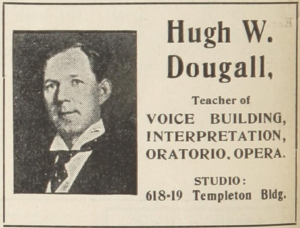
Give Me a Home in the Heart of the Mountains is a title that makes the rest of the lyrics redundant, but Hugh Dougall only did the music – not the lyrics or the title for this one, which had words by Theodore E. Curtis. His specialty as a composer seemed to be “art songs” and hymns. For his lyrics he usually used poetry by local authors, including some by Alfred Lambourne. Dougall (1872 – 1963) was another of the multi-talented fellows in the early 1900s arts scene in SLC who worked in local theater including the Salt Lake Theater and several Opera companies, and in music as a teacher, composer and vocal performer. Hugh taught through his own private studio, and led the music department at Davis High School in Kaysville for a year or so before moving on to be the supervisor of music in public education for all of Utah. Dougall’s mother was a daughter of Brigham Young. This chorus was published in 1927, and is presented here as “sung” by synthesized male voices, both tenors and baritones. Photos of Dougall and a newspaper ad for his vocal teaching studio follow the recording.

“The College Song of BYU” came from a 1927 contest organized by the student body officers, making this one sort of official – at least for a while. Annie Pike Greenwood was a student active in all sorts of creative campus activities, foreshadowing her later successes as a respected journalist and author of regional literature, fiction and non-fiction. (And her father was the lead doctor at the Utah State Mental Hospital – for whatever that is worth.) The music was supplied by William Hanson (who has other credits on this site as well) but the original sheet music says that the tune is “adapted from an old melody.” The form has a verse, followed by a chorus, then finishing with another version of the chorus for unaccompanied male voices. (Click to play the audio.)
“U. of U. Trail!” was composed in 1923 by the team of Gladys Rich doing the music, and Caddie R. Streeper providing the lyrics. Not sure if it was ever recognized as an “official” school song, since there were already other pieces for ceremonies such as graduations and for sports boosterism. But this one was certainly ambitious and boisterous, and got wide circulation in sheet music and some recordings. Rich later composed several operettas/musicals for performances by school students, and 2 cantatas on local history, including one on the story of the “Miracle of the Seagulls” pioneer legend, but that was published in 1937 so it will take a while to determine copyright status before sharing it here. (Audio only – click below to play.)
Bonus Song! Gladys Rich also penned one of the favorite American “art songs” used by singers when they are trying to make a good impression in an audition. It seems like a simple one, but the bluesy phrasing can make this one stand out. The lyrics are sung as by a nursemaid trying to soothe a baby who has both parents absent for the day. “American Lullaby” from 1932 is tinged with sadness, as a depression era song deserves to be. It has dozens of versions on YouTube, but this one led to a big bump in popularity for it. Not sure of the copyright status yet, so for now we’ll simply link to a good version someone else posted. (Click the title to hear it, and look below to see the AI touch-up of a b/w photo of Gladys from a 1930s newspaper.)

Oh, It’s Joy to be a Junior Girl was the winner in a 1926 contest seeking songs for youth groups to perform. It seems that the term “Junior Girl” was likely referencing the title applied to a certain age group of the time. Lyrics were by Angelyn Warnick with music by Roland C. Parry, who was the stalwart of Ogden, Utah’s Weber State College (under various names) music department for decades. We’ll look into adding some of his other works someday, but his dates of composition for later works straddle the line where copyright rules may apply. This one is presented here by substituting a piccolo (small flute) for the young girl’s voice. (Click below to play the audio.)
UPDATE: We have just stumbled on to an additional set of a few more of his recreational songs for teen voices. We’ll check into adding these, but the copyright situation is a bit cloudy on them.
Song of the Ute – Wow, after posting 100 examples of historic music from Utah, I’m finally concerned about whether or not to list this song from 1929. Generally, I believe that an artist should be free to do any kind of work they wish, as long as it does not hurt anyone who does not deserve it. But this one does hurt. The lyrics were by humorist Hamilton Park, who was seemingly in the advertising and promotion business, as well as writing an ongoing column of local humor for one of the big daily papers in SLC. The music was by Seldon Heaps, an undeniably talented composer and performer who sort of specialized in theater organ playing. So it is not the LEVEL of the work, but the concept of it that stings. This is a “comic” song with absolutely rude cover art and lyrics branding Native Americans as dirty savages, and the simplest stereotypical melody depicting generic “Indian” music. I’ve decided to put the instrumental music on here as a historical oddity, but will not share the lyrics or cover art. Apologies. (Click to play it,)
Billy Hill – a short time Utahn with a big resume. (1899 – 1940) Billy Hilly wrote HillBilly music. Yes, that was his real name! He had mixed feelings about being stereotyped, but it sometimes got him traction in the music business. An interesting character, he started as a promising violin player in Boston, who studied in conservatories and even played in the Boston Symphony. Then he got the wanderlust, travelling the western states “in search of himself” and a career. Along his travels he took various odd jobs, which included temporary music jobs when possible. He is said to have started the first professional Jazz Band in Utah in a Chinese restaurant in Salt Lake City. which may have gotten him back into making music a full-time thing again. Beyond performing, he always wrote songs in “popular” styles from jazz to pop to “HillBilly Music.” Not a sophisticated business person yet, he often sold the rights to his songs for $20 to pay his bills for a month, then saw some of those songs make other people rich. He finally found some friends who steered him into the right way to get paid for his work, and soon he was making a real success from his talent. Part of that was adopting the pseudonym “George Brown” for situations where the music style seemed a more jazz/pop feel, and used both names as the situation dictated. His biggest commercial hit was probably “The Glory of Love” in 1936 which was covered (recorded and released) by such names as Benny Goodman, Peggy Lee, Otis Redding and Paul McCartney! But since this is a Utah themed page, the sample we’ll share is a 1930 song called “Rock Me To Sleep In My Rocky Mountain Home.” (Click the title to hear it as posted on YouTube by someone else.)
A. W. “Mickey” Hart may forever have his name confused with the famous Grateful Dead percussionist Mickey Hart, but Utah’s composer lived and worked in an entirely different type of music. Hart (1905-2007) specialized in sacred songs, writing over 350 pieces, including a few full albums of religious songs sung by Jesse Evans Smith marketed to the LDS community. However, he also was fluent in pop/jazz music, played with major touring big bands, and even wrote an original musical titled “Keep the Customer Satisfied,” and possibly a symphony! That would have been enough for most people, but not Mickey, who at various stages taught music at several area High Schools, published dozens of his songs both through national companies and through self-publishing, and was part of the family-run HART BROTHERS music store in Salt Lake City. As an example, here is one of his secular songs titled “Here’s to Utah“. Here are two of our original recordings – first as he wrote it as a song for Jesse Evans Smith followed by an even more bombastic arrangement for full orchestra. As an instrumental it is in the family of “Marches”, but without a “break-up strain” to add a new melody for variety – so this piece has just the same verse repeated, plus a few of our own embellishments. It was copyrighted and published in 1957, but searches seem to indicate that the copyright was not renewed, making it legal to share. (If that is not accurate, please let us know and it will be taken down promptly.)
“Marshes of Glynn” by Jay Welch. This 1959 composition was originally for orchestra, chorus and soloist, but this recording is a reduction for piano and solo voice. Welch was a wonderful musician with stints as the director of the Mormon Tabernacle Choir, his own independent professional chorus, and many years as a music instructor at the University of Utah. (I took a class from him there!) The text for this work was from celebrated Southern poet Sydney Lanier, and obviously was meaningful to the composer. The full work with orchestra was recorded at the U. of U., but my copy is buried somewhere in storage, so I was glad to find and share this alternative version which contains only the solo vocalist and piano, omitting the choral passages. (Click the title to hear it on YouTube, posted by someone else – not me.)
Palmyra 1820 by composer James Prigmore (1943 – 2019) who had a rich history in Utah and national professional music circles, from orchestral to vocal to theatre, dance, film and TV score music and beyond. “Palmyra 1820“, based on LDS Church history, was a major work for chorus and orchestra, and was given a premier in the Mormon Tabernacle in the 1960s. A limited number of vinyl/LP records were made of the concert, and I was happy to share one with the composer, who did not have a copy for himself, about a year before he passed away.
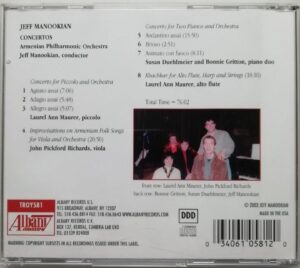
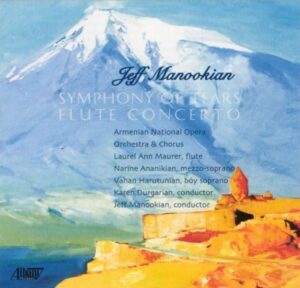
Arches, a song for Wordless Vocal and Piano from the year 2002 by Jeff Manookian. This is certainly the most “modern” and modern sounding work on this site, and here’s why it can be on here despite being such a recently published piece. Jeff Manookian was a wunderkind piano student in the early 1980s at the U. of Utah, when I was just a band geek there. But we had some great conversations about music, and met again 20 years later at an event we were both working on for the Utah Arts Council. He was a perpetual motion composer, with output ranging from piano solos to huge symphonies. Some of those orchestral works celebrating his Armenian musical heritage were recorded by contemporary music labels. His career was international as a resident conductor for a South American orchestra, and many projects and recordings around the world. He also had deep roots in Utah and loved the land. He composed at least two works named after local wild places, including this song, which is just one in a set of three songs. Very sparsely scored, with single lines ruling the day, and LOTS of empty space. The vocal line(s) are mostly in unison, but have a very few chords as well. As usual for our new recordings on this site, this recording uses synthesized voices. Being wordless by design, in this case it may be a bit closer to the composer’s conception than most other songs we’ve made recordings for here. Before he passed away in 2021 Jeff classified almost 200 of his compositions, large and small, as “Creative Commons” status, meaning he still claimed authorship but was allowing free use of the music in many situations. (Click the title to hear the song in a video.)

“Lilly Dale” is offered as an extra, for the trivia value alone. It needs a bit of explanation as far as why it is on this list. This sentimental ballad about a young woman struck down in her prime was in the general style and time period as Stephen Foster songs. The composer was H.S. Thompson (no connection to Utah) and this song was a big hit in 1852. (Note that some versions spell the title as “Lilly” while other use “Lily.”) There were endless arrangements, sequels, and imitators. One version with a Utah connection was that in 1854 Charles W. Penrose “borrowed” the tune for his song/hymn “Oh, Ye Mountains High.” The original version by Thompson was scored for piano, solo vocal on the verses, and s.a.t.b. quartet on the chorus. I’ve swapped in a string quartet for the voices, and it is presented here in just a single verse as a demo of the original style. (Audio only, click below to play.)

Really? Why so few vocal recordings? Sorry – we are actively looking for better ways to present vocals works as well. But without access to live performers there is not yet much chance of having good quality vocal recordings here. We are looking into the various A.I. singing software options to see if they might yield results which can closely honor the original intent. Something might work out by mid-2026. Yes, there are MANY songs, serious and satirical, which would fit nicely here, and we have quite a few examples of sheet music on hold for that time.
But for now, please accept my apologies. If you are interested in performing vocal music that fits the themes of this site please let us know. We would love to have some better vocal recordings to share here. We can even suggest or supply sheet music that is on point.
Same if you already have audio or video recordings you would be willing to share. I could link to your own YouTube videos to ensure that you get full credit and “clicks,” if permission is granted to link from here. Selections would (usually) need to be pre-1930, or have other ways of navigating the issues of Copyrights and Public Domain status.
Thanks!