 Utah Classical Music of the Past
Gallery of new recordings of old music - for the curious or the studious
Utah Classical Music of the Past
Gallery of new recordings of old music - for the curious or the studious
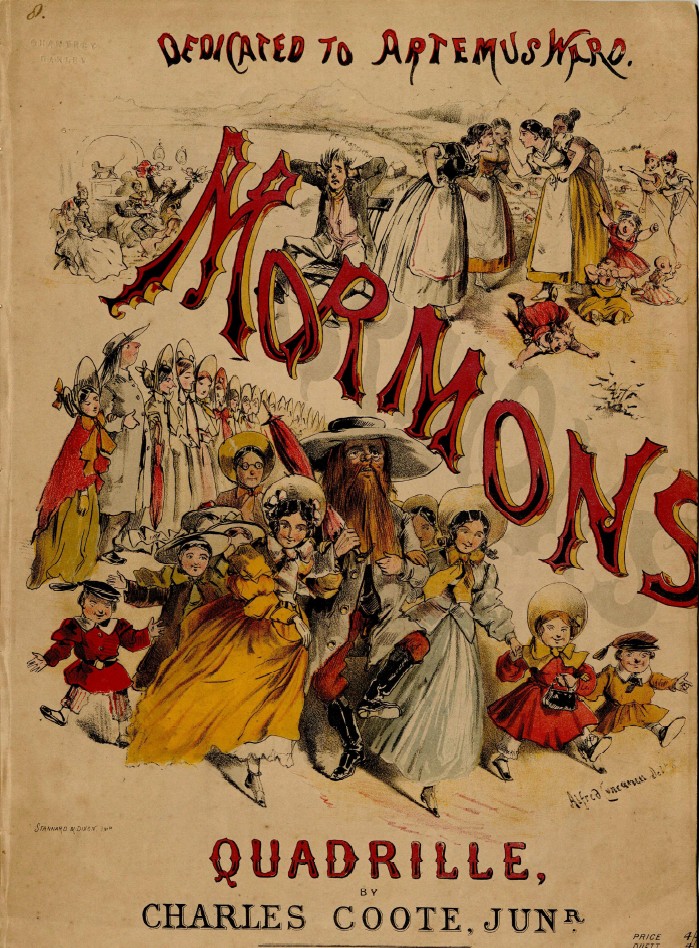
The Mormons Quadrille (1860s?) – In the era of Gilbert & Sullivan there were many other composers producing light operetta and similar “music hall” entertainment. One such musician was Londoner Charles Coote, Jr., who wrote dozens of crowd-pleasing works. Little is known about this piece except that from the cover art of the sheet music it appears to have been a comic farce lampooning polygamy and American Bravado. Based on the many musical quotes included, it seems to be an instrumental suite rather than an overture from a play. More details to come later when the video is completed, but you can listen to the audio now – so click it, if you dare. There will certainly be a video coming for this one someday due to the many musical quotes, references and quirks of the piece. Thanks go out to the Special Collections department of BYU’s Lee Library who supplied a copy of the sheet music from their holdings. (Click below to play.)
Utah March of 1858 by Emanuel Marquis. Apart from the title there is nothing particularly connecting either the composer or the music to the region. From a time when composers churned out volumes of sheet music for a music-hungry public, this is what it is – a simple, but unremarkable addition.
The Mormon War – A Grand March by Peter Ricksecker from 1858. The title is striking, but maybe not as dramatic as it teases. There was certainly a series of troublesome conflicts around 1858, about a decade after the pioneers settled in Salt Lake City. The episode became widely known as the “Mormon War.” Actually, it was more of a diplomatic power struggle, as the leaders in Washington DC did not like the way the Mormon (now LDS) leaders in the Utah Territory were running things in ways that the Feds did not approve of. (Participle dangled.) Troops were even sent to Utah as a show of federal force, with the side benefit that several military bases were established throughout the conflict, and those added to the cultural variety in the region. However despite the tensions cooler heads prevailed, and little happened other than posturing and taunting, which continued until Utah was finally granted statehood in the 1890s. But the name “Mormon War” was catchy, so composer Peter Ricksecker of the musically minded Moravian Church movement in Pennsylvania wrote this piece to capitalize on the news of the day. While it is clearly tied to Utah by subject and title, the composer himself probably had no serious connection to Utah. While not by a Utah Composer per se, it is welcome here as a relative. Shots fired, but War settled. This is another recording by Tim on Fiverr, but for this one he not only played and recorded it, he also solved a musical mystery by extracting a playable score from the original which had several pages of inky notes smudged together due to previous water damage in the archived sheet music.
Deseret Schottische by Geraldine Warden – Composed by a touring Australian opera singer who visited Salt Lake City for a short series of concerts in 1868, and wanted to leave this musical gift for the many nice people she met and befriended in Utah. She was considered a major “star” as a singer, but was also a versatile and talented pianist who sometimes accompanied her fellow singers as they performed. A synthesized piano track is used in this recording on YouTube.
My Love He is a Mormonite – a comic song for ladies with a small chorus for s.a.t.b. voices. Credited to composer Harry Miller from 1871 with lyrics showing the singer holding a surprisingly nonchalant (or is it oblivious?) attitude about her husband’s polygamous ways, even though she does not share those beliefs. Possibly from a theatrical show or review. Here are the lyrics to the first verse: “My love he is a Mormonite, a Mormon to the letter, and although he has a dozen wives he loves me all the better. Then, faith! Why puzzle my poor head at all in this strange matter? For he’s told me very often that he loves me faithfully, and this chap I love so dearly comes from Salt Lake City.”
Up in Mormon Land – A comic song from a New York City theater’s burlesque review titled “Blue Beard” from 1873. There is little specific evidence of the authorship of the words or music for this one, as only the lead performer and the music arranger are credited on the sheet music. It is even possible that the show was more of a collection of novelty songs assembled into a show rather than something with a through theme and plot. The lyrics simply glow about the idea of finding extra chances of meeting someone to love by visiting “Mormon Land” where more than one relationship at a time is embraced. Vocal line replaced by flute here. (Audio only – click below to play.)
Brigham Young – Grand March – from 1873 by Edward Mack. Again, not a Utah composer, but shared here because of the subject. Tuneful rather than “Grand”, but still a pleasant if rather repetitive march. The composer is lesser known now, but was quite prolific in his day, publishing more than 100 pieces as sheet music in the late 1800s despite having lost his eyesight as a Young adult. (Get it? Young? … oh, nevermind …)
Oh, How Wicked the Mormons Are was one of many comic songs of the late 1800s making merry about Mormons, and by extension, anyone in Utah. Some were less tongue-in-cheek, but this one was mostly for fun. From the limited info printed on the sheet music it might have been from the “Music Hall” shows in England that were like Vaudeville in the Americas. When we figure out how to present vocals this will be one of the first we re-post.
Deseret – or a Saint’s Affliction was a “Comic Opera” from 1880 by major composer Dudley Buck, noted as being among the first respected composers to be educated entirely in America. A friendly lampooning of Mormon, and by extension Utah life. But really more of a “romantic troubles” plot compounded by the shadow of polygamy, which was how many in east coast circles saw Utah. Easy to joke about, but not particularly mean-spirited. The composer later had several of his choral anthems included in LDS songbooks for choirs and Temple dedications, so no hard feelings. Most of the musical score of this full opera is lost, but seven short songs were published separately, and this piece, titled “Serenade“, is one of those. Starts as a solo for a Baritone voice as he sets out to woo a particular young lady. But as he sings outside her window, he accidently captures the attentions of all the OTHER ladies in the area, who join in his song. (Audio only – click below to play.)
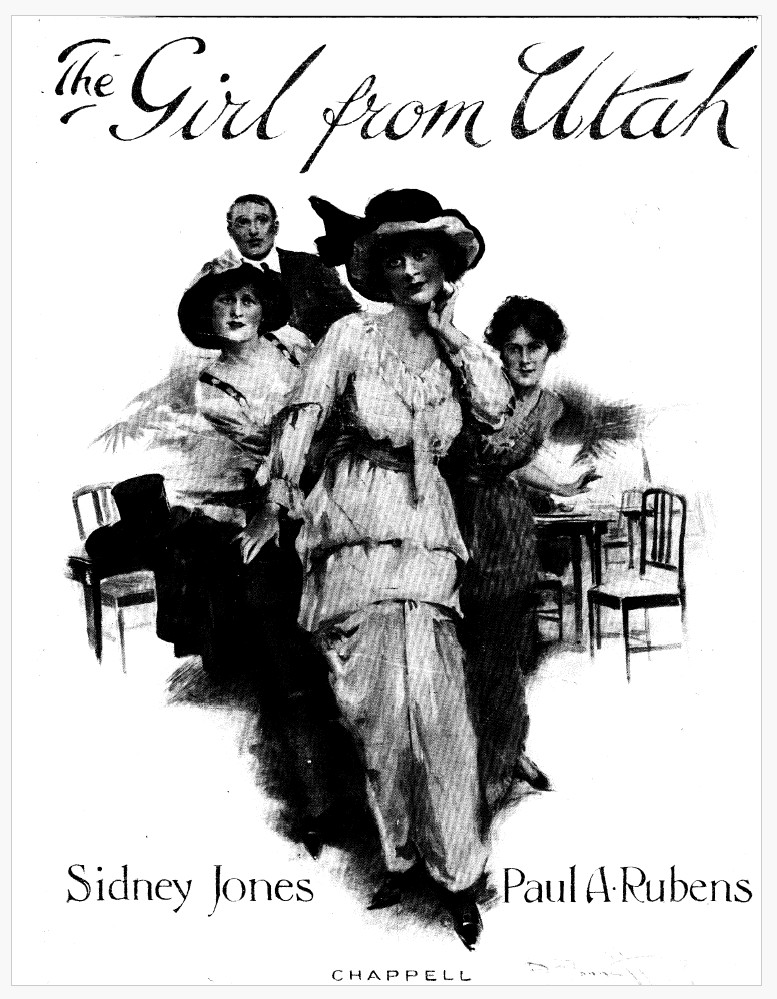
“The Girl from Utah” was a musical comedy which debuted in London in 1908. The plot was that a wonderful young woman from Utah moved (escaped?) to England to avoid an arranged marriage to a Utah man she did not love. There she met a variety of worldly people who, at first, treated her as a curiosity, with lots of culture clash plot points. But eventually she charmed them, especially one man. When her spurned suiter arrived from Utah, her new continental friends helped her escape his clutches to marry the new guy. This work originated in England at a time when anti-Mormon (and by extension anti-Utah) books, songs, plays, etc. were common. Some were quite serious in tone, but many others were more comedic, such as this one. The play was moderately popular, and was revived in New York a few years later with additional new songs by Jerome Kern, but his additions did not allude to Utah. The selections presented here are all from the original London staging, featuring works by two different teams of composers and lyricists, who each wrote complete songs but did not appear to share credits on songs. This short suite presents only the instrumental passages from the original score’s piano reduction. It includes 1) an “Introductory Chorus”, 2) a “Dance”, 3) a long “Tango”, and 4) a final “Russian Dance.” (An audio-only recording. Click to play.)
Two Blues/Jazz Songs about Utah? (click the titles below to hear them) OK, so these two are here because they were extreme examples of vintage comic songs in a Blues or Jazz style with lyrics about Utah/Polygamy/Mormons. Not traditional classical music at all, but still interesting as “outsider” songs commenting on Utah. The first is “Utah Mormon Blues” performed by Phil Paver around 1929, but composed by Spencer Williams, Jr., a rather major star in the Jazz/Blues scene of the time. Williams also wrote the jazz standard “Basin Street Blues”, and had theatrical careers including making films, and as one of the lead actors on the “Amos and Andy” radio show. The second song was obviously thought to be using vocabulary that was fairly provocative, but also standard in it’s time. It is way beyond acceptable now, except as a historical reference so I won’t print the title here to avoid getting it indexed as part of this page by search engines. But if you are curious and can take a rude old joke as entertainment or social/historical research, click this next link to see and hear the Second Blues/Jazz Song from 1905 with the lyrics in the description.
Utah – A Mormon Foxtrot by English (?) composer Elliott Smith from 1922 has the feel of a “Music Hall” entertainment song. The musical mood is dark, but the lyrics are witty, warning UK girls about “predatory Mormon Missionaries” who came to England to find converts – especially young plural wife material. A few lines from the lyrics are:
Elder Brown came to town looking for a bride.
Girls he saw by the score, you can bet he tried.
“I’ve got six wives down Utah way But seven’s lucky, so they say.
I’ve just room for one wife more Down by that Salt Lake shore.”
Other than the subject matter, there is no sign of this having local composer connections. (Audio only – click below to play it with a violin in place of the original vocal. There is also a simple video linked to the title, but it does not always work…)
Deseret – A full scale grand opera shown live on national TV on NBC in 1961 when the major television networks occasionally tackled serious arts event programming. Composed by the multi-talented Leonard Kastle, who also directed an acclaimed noir detective movie. This work has a plot revolving around the drama and turmoil of a reluctant young plural bride candidate for Brigham Young. Not especially anti-Mormon or pro-Mormon so much as an artistic look at a dramatic/historic situation explored on stage. This is not a project of mine, but I’m linking it here as an item of note on the topic of classical music in Utah history. The video for this production was not preserved, which was sadly routine for TV networks of that time period, and the entire production was thought to be lost until a few years ago when a nearly complete copy of the audio was found in the personal archives of one of the performers. A few copies of the conductor’s score were printed and might be found in regional libraries. (And one on my own bookshelf!) Hear almost 2-hours of audio from the opera – nearly complete but missing a few scenes – at https://www.youtube.com/watch?v=V3o-jEcpqnI If “Opera on Mormon Themes” is of interest to you, a long article on the subject from the Deseret News in 2009 mentions over 50 such works, with or without Utah composers. Read it at: https://www.deseret.com/2009/1/17/20377941/mormons-opera-and-mormon-operas/
“From the Canyon to the Stars” by Olivier Messiaen The modernist French composer was commissioned in 1971 to compose an orchestral work, and he brought his usual signature sensibilities to the project. It includes orchestral renditions of actual bird calls he heard while visiting southern Utah wild places, particularly Cedar Breaks National Monument and Bryce & Zion National Parks. The Utah Symphony has performed scattered movements from the long piece over the years, but made the bold move to play the entire piece at an outdoor amphitheater just outside Zion National Park in 1922. It is scored for an unusual combinations of instruments – sort of a set of chamber orchestras sharing a stage. I’m glad I was there to hear it live in that setting, which will probably never be repeated. Click the title above to hear an online recording, but be prepared to deal with music that is sometimes more intriguing than “pretty.”
John Duffy – Symphony #1 “Utah” was recorded around the time of the premiere in 1989. It is in standard symphonic form, tonal, and inspired by the remarkable landscapes of central and southern Utah. Various movements are posted (by others) on YouTube, including this excerpt by the Utah Symphony.
… MORE MENTIONS …
David Crumb composed the chamber music “Red Desert Triptych” inspired by Arches National Park.
Richard Adler’s “Wilderness Suite” was inspired by Southern Utah scenes, among other spots, and was commercially recorded by the Utah Symphony.
David Bohmler composed an Opera based on the Zane Grey novel “Riders of the Purple Sage” which was set in Southern Utah in pioneer times, and dealing with strife between zealous Mormon religious groups and general settlers.
Dan Welcher wrote a piece titled “Zion” with versions for either orchestra or concert band.
John Corigliano composed a “Utah Fanfare” for brass and percussion which was commissioned to be used to open “Gardner Hall,” the new concert hall at the University of Utah’s music department in the year 2000. It appears that the sheet music is available by rental only, and no recording was found in a quick search. It calls for a large brass ensemble with instruments both on stage and off stage (in the audience!) plus a smaller part for percussion.